10 Important Points You Should Know (2026)
Published by i Square Electricals
Electrical Design | Solutions | Consultancy
📌 10 Important Key Points
1. Definition
Earthing and Grounding
Earthing and Grounding
Electrical safety is a fundamental requirement for every electrical installation. Whether it is a residential home, commercial building, industrial plant, hospital, or data center, a well-designed electrical system must include both earthing and grounding.
Although these terms are often used interchangeably, they serve different purposes and are equally important.
What is Earthing?
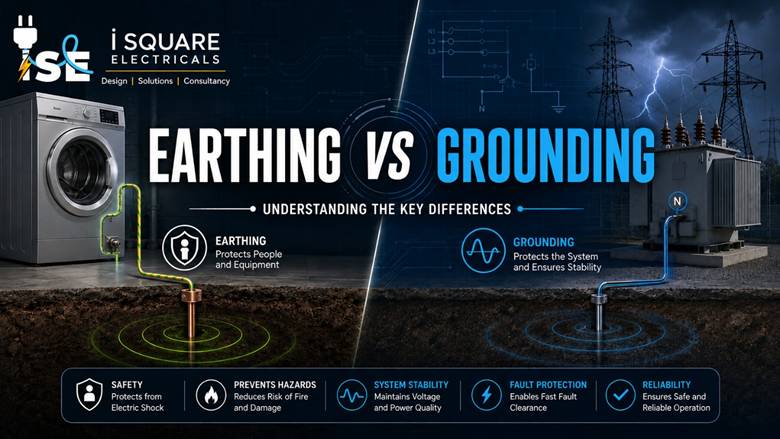
Earthing is the process of connecting the non-current-carrying metallic parts of electrical equipment to the earth through a low-resistance conductor.
Under normal operating conditions, no current flows through the earthing conductor. During an insulation failure or fault, the fault current safely flows into the earth, protecting people from electric shock.
Example
If the metal body of a washing machine accidentally becomes live due to insulation failure:
- Without earthing → A person touching it may receive an electric shock.
- With proper earthing → Fault current flows into the earth and the protective device trips immediately.
What is Grounding?
Grounding is the intentional connection of the neutral point of transformers, generators, or electrical systems to earth.
Grounding provides a stable voltage reference and allows protective devices to operate correctly during faults, lightning strikes, and switching surges.
Example
A distribution transformer supplies 415/230 V.
Its neutral is connected to earth, which helps:
- Maintain system voltage
- Improve fault clearing
- Prevent neutral shifting
- Protect equipment
2. Purpose
Although both systems are connected to the earth, their objectives are different.
Purpose of Earthing
- Protect people from electric shock
- Prevent fire hazards
- Keep equipment bodies at earth potential
- Provide a safe path for fault current
- Operate protective devices quickly
Purpose of Grounding
- Stabilize system voltage
- Provide a voltage reference
- Improve fault detection
- Protect transformers and generators
- Reduce overvoltage caused by lightning and switching surges
3. Key Differences
| Parameter | Earthing | Grounding |
| Purpose | Human Safety | System Safety |
| Connected To | Equipment Body | Neutral Point |
| Current Flow | Only During Fault | May Carry Current |
| Protects | Human Beings | Electrical Equipment |
| Used In | Electrical Equipment | Electrical Network |
| Voltage Reference | No | Yes |
4. Types
Types of Earthing
Plate Earthing
Uses copper or GI plates buried underground.
Suitable for:
- Residential buildings
- Commercial buildings
Pipe Earthing
Uses a galvanized iron pipe as the earth electrode.
Suitable for:
- Residential
- Commercial
- Industrial applications
Most commonly used in India because it is economical and effective.
Rod Earthing
Uses copper or GI rods driven deep into the soil.
Suitable for:
- Rocky areas
- Limited installation space
- Telecom towers
Strip or Wire Earthing
Uses copper or GI strips buried underground.
Suitable for:
- Industrial plants
- Substations
- Large electrical installations
Types of Grounding
- Solid type
- Resistance type
- Reactance type
- Petersen Coil type
- Ungrounded System (Special Applications)
Each type is selected based on system voltage, fault current, and application.
5. Importance
A properly designed protection system offers several advantages.
Importance of Earthing
- Protects human life
- Prevents electric shock
- Reduces fire hazards
- Improves electrical safety
- Protects appliances from insulation failure
Importance of Grounding
- Maintains voltage stability
- Improves power quality
- Protects expensive equipment
- Helps protective relays detect faults
- Reduces transient overvoltages
6. Standards
Electrical earthing and grounding should always comply with recognized national and international standards.
Common standards include:
- IS 3043 – Code of Practice for Earthing (India)
- National Electrical Code (NEC) – USA
- IEC 60364 – Low Voltage Electrical Installations
- IEEE Std 80 – Substation Grounding
- IS/IEC 62305 – Lightning Protection
Following these standards ensures safety, reliability, and regulatory compliance.
7. Applications
Earthing and grounding are used across almost every electrical installation.
Residential Buildings
- Home wiring
- Distribution boards
- Water heaters
- Air conditioners
Commercial Buildings
- Offices
- Shopping malls
- Hospitals
- Hotels
Industrial Plants
- Motors
- Control panels
- MCCs
- Transformers
- DG Sets
Critical Infrastructure
- Data Centers
- Telecom Towers
- Solar Power Plants
- Electrical Substations
- Manufacturing Facilities
8. Common Mistakes
Improper installation can compromise electrical safety.
Common mistakes include:
- High earth resistance
- Loose earthing connections
- Corroded earth electrodes
- Undersized earthing conductors
- Poor bonding between equipment
- Not testing earth resistance periodically
- Using low-quality earthing materials
- Improper grounding of transformer neutral
Avoiding these mistakes improves both safety and system reliability.
9. Best Practices
For a reliable earthing and grounding system:
- Design according to applicable electrical standards.
- Maintain low earth resistance.
- Test earth resistance regularly.
- Inspect earth pits periodically.
- Use high-quality copper or GI materials.
- Properly bond all metallic equipment.
- Correctly ground transformer and generator neutrals.
- Maintain complete documentation and maintenance records.
- Conduct periodic preventive maintenance.
- Ensure all work is performed by qualified electrical professionals.
10. Conclusion
Earthing and grounding are two essential components of every safe electrical installation.
While earthing protects people by safely carrying fault current to the earth, grounding protects the electrical system by providing a stable voltage reference and enabling reliable fault operation.
Although the terms are often confused, understanding their differences is crucial for designing safe, efficient, and compliant electrical systems.
Whether you are designing a residential home, commercial building, industrial facility, or utility network, investing in a properly engineered earthing and grounding system is one of the most important steps toward long-term electrical safety and reliability.
Need Professional Electrical Design?
At i Square Electricals, we provide professional electrical design and consultancy services for:
- Underground Electrification Design
- Residential Electrical Design
- Commercial Electrical Design
- Industrial Electrical Design
- Single Line Diagrams (SLD)
- Load Calculations
- Cable Sizing
- Voltage Drop Calculations
- Earthing & Grounding Design
- Electrical Consultancy
Designing Safe. Reliable. Efficient Electrical Systems.