Understanding the Key Differences, Importance, Types & Best Practices
Published by i Square Electricals
Electrical Design & Solutions
Introduction
Electrical safety is one of the most critical aspects of any electrical installation. Whether it’s a residential house, commercial building, industrial plant, hospital, or data center, a properly designed electrical system must include an effective earthing and grounding system.
However, these two terms are often misunderstood. Many people—including electricians, students, and even some engineers—use earthing and grounding interchangeably. Although they are closely related and both involve connecting an electrical system to the earth, they are not the same.
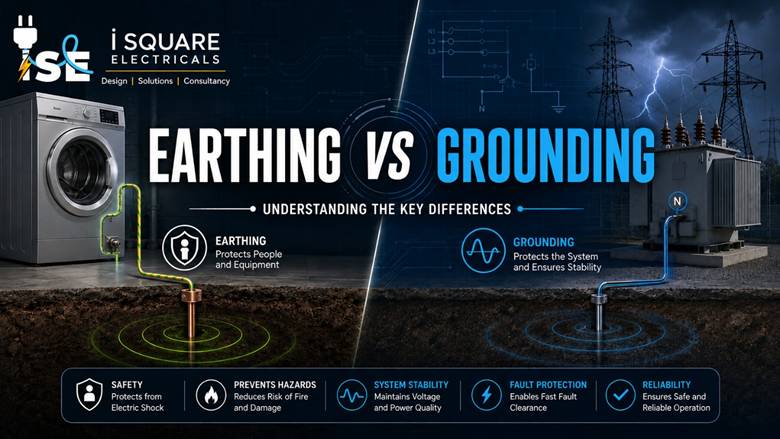
Understanding the difference is essential because both systems perform different functions. Earthing primarily protects people from electric shock, while grounding protects the electrical system, equipment, and ensures stable operation.
What is Earthing?
the process of connecting the metallic body (non-current carrying parts) of electrical equipment to the earth using a low-resistance conductor.
Under normal conditions, no current flows through the conductor.
If insulation fails or a live conductor accidentally touches the metallic body of equipment, fault current immediately flows through the conductor into the ground instead of passing through a person.
This causes protective devices like:
- RCCB
- MCB
- MCCB
- ACB
to trip instantly, disconnecting the faulty circuit.
Example
Imagine your washing machine develops an insulation fault.
Without earthing:
The outer metal body becomes live. When someone touches it: Electric current passes through the person’s body.
Result: ⚠ Electric Shock
With proper earthing:
Current immediately flows into earth. Protective device trips. Machine switches OFF.
Result: Person remains safe.
What is Grounding?
is the intentional connection of a current-carrying conductor, usually the neutral point of a transformer or generator, to earth.
Grounding ensures that the electrical system always maintains a stable voltage reference.
It also enables proper operation during:
- Earth faults
- Lightning
- Switching surges
- Voltage imbalance
It is primarily for system protection, not direct human protection.
Example
A distribution transformer supplies 415/230V.
The neutral is connected to earth.
This:
- Maintains voltage stability
- Limits overvoltage
- Clears faults faster
- Improves power quality
Comparison
| Parameter | Earthing | Grounding |
| Purpose | Human Safety | System Safety |
| Connected To | Equipment Body | Neutral |
| Current Flow | Only during Fault | May carry current |
| Protects | Human Beings | Electrical Equipment |
| Used In | Equipment | Electrical Network |
| Voltage Reference | No | Yes |
Why Both are Necessary
Many people ask,
“If grounding already connects to earth, why do we also need earthing?”
Because they solve different problems.
Earthing protects people.
Grounding protects the electrical system.
Without earthing:
- Electric shock risk
- Fire hazard
- Equipment body becomes live
Without grounding:
- Voltage instability
- Equipment damage
- Neutral shifting
- Fault detection problems
Best Practices for a Safe Electrical System
- Design earthing according to applicable standards.
- Maintain low earth resistance.
- Inspect earth pits periodically.
- Test earth resistance regularly.
- Ensure all metallic equipment is properly earthed.
- Ground transformer and generator neutrals correctly.
- Use quality earthing materials.
- Maintain proper bonding throughout the installation.
Why Professional Electrical Design Matters
A properly engineered earthing and grounding system is not just about compliance—it is a critical investment in safety, reliability, and long-term performance.
At i Square Electricals, we provide professional electrical design and consultancy services for:
- Underground Electrification Design
- Residential Electrical Design
- Commercial Electrical Design
- Industrial Electrical Design
- Single Line Diagrams (SLD)
- Load Calculations
- Cable Sizing
- Voltage Drop Calculations
- Electrical Consultancy
Every project is designed with safety, efficiency, and compliance in mind.
Conclusion
Earthing protects people by safely directing fault currents into the earth, while grounding protects the electrical system by providing a stable reference point and ensuring reliable fault operation.
Although the terms are often used interchangeably, understanding their differences is essential for designing safe and dependable electrical installations.
Whether it’s a home, commercial building, or industrial plant, investing in a properly designed protection system is one of the most important steps toward electrical safety.
Need Professional Electrical Design?
If you’re planning a residential, commercial, or industrial project, i Square Electricals offers expert electrical design, consultancy, and engineering solutions tailored to your requirements. Contact us today to discuss your project and ensure your electrical system is designed for safety, efficiency, and long-term reliability.